
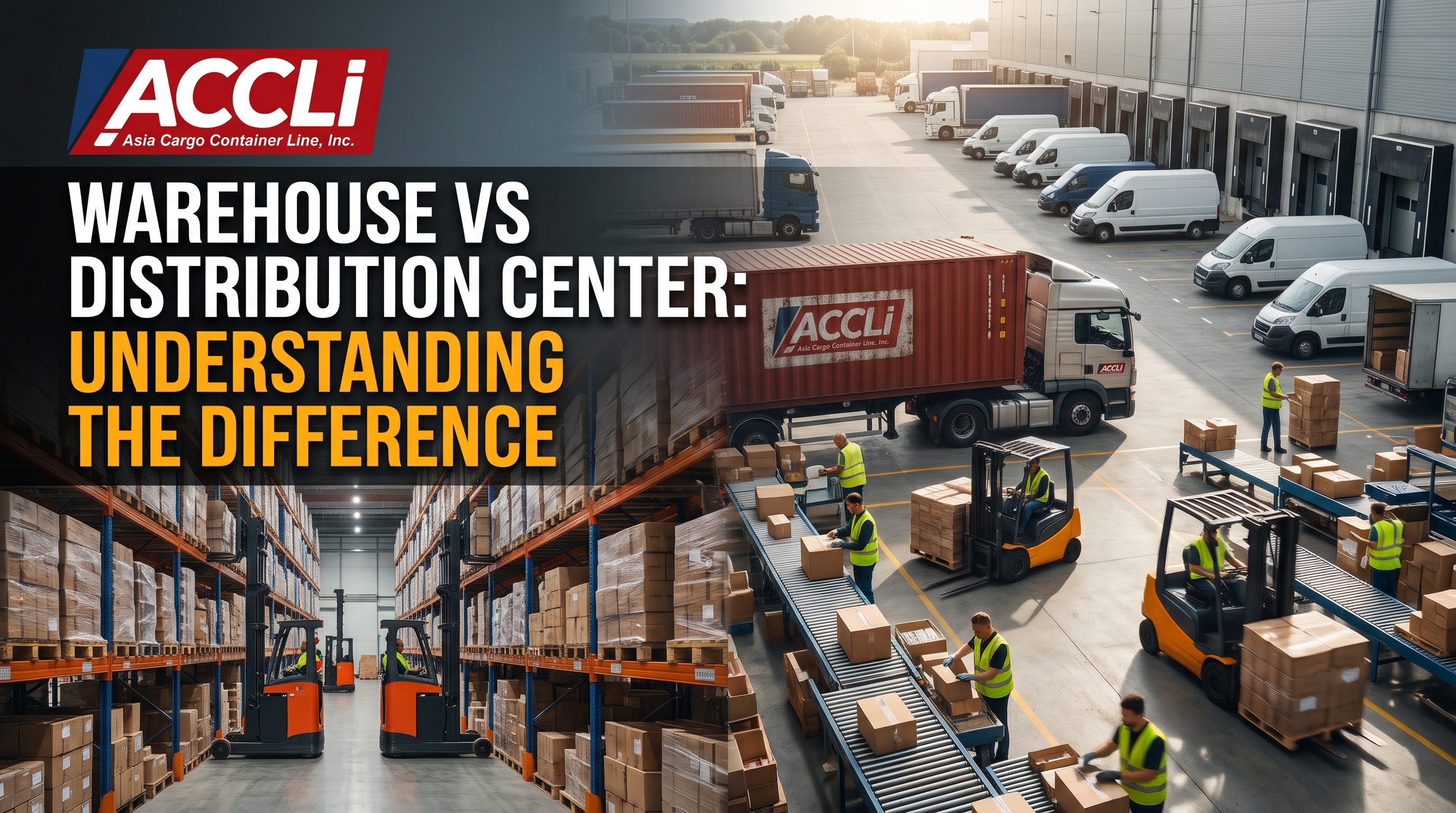
Businesses that manage physical products need reliable facilities to store inventory and move goods throughout the supply chain. Two common logistics facilities are warehouses and distribution centers. Although they may look similar, they serve different operational purposes.
Understanding the difference between a warehouse and a distribution center helps businesses choose the right logistics setup based on their inventory requirements, order volume, delivery schedules, and distribution strategies.
A warehouse primarily focuses on storing and managing inventory, while a distribution center emphasizes the movement, processing, and delivery of goods to their next destination. Some facilities perform both functions, depending on the company’s logistics requirements and available services.
What Is a Warehouse?
A warehouse is a facility designed to receive, store, protect, and manage goods until they are needed for production, sale, or distribution. It provides businesses with space to maintain inventory and manage product availability.
Companies use warehouses to keep raw materials, components, finished products, and other merchandise in a controlled and organized environment.
Common Warehouse Functions
Warehouse operations generally involve the following activities:
- Receiving: Accepting incoming goods from suppliers, manufacturers, or transport providers.
- Inspection: Checking the quantity and condition of delivered products.
- Storage: Placing inventory in designated locations to maintain organization and accessibility.
- Inventory Management: Monitoring stock levels, product movement, and inventory records.
- Order Preparation: Retrieving requested products when inventory needs to be released.
- Dispatch: Preparing stored goods for transportation to their next destination.
Why Businesses Use Warehouses
Warehouses help businesses maintain sufficient inventory to support daily operations and changing customer demand.
For example, a Philippine distributor importing consumer products may receive several containers of merchandise from overseas suppliers. Instead of immediately sending all products to retailers, the company can store them in a warehouse and release inventory according to actual demand.
This approach helps businesses manage stock availability, organize inventory, and prepare for seasonal demand fluctuations.
What Is a Distribution Center?
A distribution center is a logistics facility designed to receive goods, process orders, consolidate or separate shipments, and move products efficiently to their intended destinations.
Unlike facilities primarily focused on long-term storage, distribution centers emphasize inventory movement and order processing. Products may remain in the facility for a relatively short period before being dispatched to retailers, business locations, or customers.
Distribution centers are particularly useful for businesses managing large shipment volumes and serving multiple locations.
Common Distribution Center Functions
Distribution center operations may include:
- Receiving and Verification: Checking incoming shipments against purchase orders and delivery documents.
- Sorting and Consolidation: Organizing products based on destination, customer, or delivery schedule.
- Order Processing: Preparing inventory based on incoming customer or store requirements.
- Picking and Packing: Retrieving and preparing products for specific orders.
- Cross-Docking: Transferring eligible incoming goods directly to outbound shipments with minimal storage.
- Transportation Coordination: Scheduling deliveries and organizing shipments for different destinations.
- Dispatch and Distribution: Releasing goods for delivery to retail outlets, branches, or customers.
Why Businesses Use Distribution Centers
Distribution centers help businesses coordinate the movement of products across different locations.
For example, a retail company supplying stores in Metro Manila, Cebu, and Davao may use a strategically located distribution center to receive bulk shipments, organize inventory by destination, and coordinate deliveries to its regional outlets.
This arrangement can improve replenishment schedules, reduce unnecessary handling, and support more organized distribution operations.
Warehouse vs Distribution Center: Key Differences
The main difference between a warehouse and a distribution center is their primary operational focus. A warehouse prioritizes inventory storage and availability, while a distribution center prioritizes product movement and distribution efficiency.
| Comparison | Warehouse | Distribution Center |
|---|---|---|
| Primary Purpose | Storage and inventory management | Product movement and distribution |
| Main Focus | Inventory availability and protection | Order processing and delivery |
| Storage Duration | Often longer-term | Generally shorter-term |
| Core Activities | Receiving, storing, tracking, and releasing goods | Receiving, sorting, picking, packing, and dispatching |
| Inventory Movement | Based on storage and replenishment requirements | Based on orders and distribution schedules |
| Typical Users | Manufacturers, importers, wholesalers, and distributors | Retailers, manufacturers, wholesalers, and large distributors |
| Operational Priority | Storage utilization and inventory accuracy | Throughput, order accuracy, and delivery coordination |
These distinctions describe common operational models rather than strict rules. Modern logistics facilities may combine warehouse storage and distribution activities under one operation.
How Warehouses and Distribution Centers Work Together
Warehouses and distribution centers are not necessarily competing logistics solutions. In many supply chains, they complement each other to support inventory management and product delivery.
A business may use a warehouse to maintain bulk inventory while relying on a distribution center to process orders and coordinate deliveries to different destinations.
A typical supply chain process may follow these stages:
1. Receiving Goods From Suppliers
Products arrive from manufacturers, overseas suppliers, or local vendors. The receiving team checks shipment quantities, documentation, and product condition.
2. Storing and Managing Inventory
Goods are placed in designated storage locations. Inventory records are updated to maintain visibility over available stock and product movement.
3. Processing Orders and Replenishment Requirements
When retailers, branches, or customers require products, the business prepares the necessary orders based on stock availability and delivery requirements.
4. Sorting and Preparing Shipments
Products are retrieved, consolidated, sorted, and prepared according to their assigned destinations. Additional activities may include labeling, packaging, and shipment verification.
5. Dispatching Goods for Delivery
Prepared shipments are loaded and coordinated with transportation providers for delivery to their respective destinations.
When these activities are properly coordinated, businesses can improve inventory availability, reduce unnecessary handling, and maintain a more consistent flow of goods.
Which Is Better for Your Business: A Warehouse or Distribution Center?
Choosing between a warehouse and a distribution center depends on how your business manages inventory and fulfills delivery requirements.
Neither facility is automatically better. The appropriate solution depends on the company’s operational priorities and supply chain structure.
Choose a Warehouse If:
- Your business needs additional space for bulk inventory.
- Products must be stored before being sold or distributed.
- You maintain seasonal or safety stock.
- Inventory is released based on specific business requirements.
- Your primary concern is secure storage and inventory management.
Choose a Distribution Center If:
- Your business regularly handles high-volume shipments.
- Products must be distributed to multiple branches or retail locations.
- You require frequent order processing and shipment preparation.
- Delivery schedules and inventory replenishment are important.
- Your operations depend on efficient product movement across different regions.
Consider an Integrated Warehousing and Distribution Solution
Businesses with more complex supply chains may benefit from combining both functions.
An integrated logistics arrangement allows companies to maintain inventory while coordinating order preparation, transportation, and delivery through a connected operation.
This can be particularly valuable for importers, manufacturers, retailers, and distributors managing products across multiple locations in the Philippines.
Important Factors When Choosing a Logistics Facility
Before selecting a warehouse or distribution center, businesses should evaluate several operational considerations.
Location and Accessibility
The facility should be strategically positioned based on suppliers, ports, customers, and major transportation routes. Accessibility can influence transportation costs, delivery schedules, and overall logistics efficiency.
Storage Capacity and Infrastructure
Businesses should assess available storage space, loading and unloading areas, handling equipment, security measures, and infrastructure based on the type of products being managed.
Inventory Management Capabilities
Accurate inventory records help businesses monitor stock levels, identify discrepancies, and make informed replenishment decisions. Real-time inventory visibility can further improve operational planning.
Transportation and Distribution Support
Companies handling multiple deliveries should consider how the facility coordinates transportation, shipment scheduling, and delivery requirements.
Scalability and Operational Flexibility
Logistics requirements can change as a business grows. Choosing a provider with flexible storage and handling capabilities can help accommodate increasing inventory volumes and changing distribution needs.
How ACCLI Supports Warehousing and Distribution Operations
For businesses operating in the Philippines, reliable warehousing and distribution support can help strengthen supply chain performance.
Asia Cargo Container Line, Inc. (ACCLI) provides logistics solutions supported by over 30 years of industry experience. Its capabilities include warehousing and fulfillment, freight forwarding, customs brokerage, trucking and distribution, cold chain solutions, and value-added services.
ACCLI’s warehousing capabilities support businesses that require secure storage, inventory management, and coordinated logistics operations. By connecting warehousing with transportation and other supply chain services, businesses can work toward more organized inventory handling and product movement.
Whether your company needs additional storage capacity or coordinated logistics support for distributing goods, choosing an experienced logistics partner can help improve operational efficiency.
Visit ACCLI’s official website to explore its logistics services and discuss your business requirements.
Conclusion
Understanding the difference between a warehouse and a distribution center is essential when planning an efficient supply chain.
A warehouse primarily provides space for storing and managing inventory, while a distribution center focuses on processing and moving products to their intended destinations. Although their functions differ, both facilities play important roles in maintaining product availability and supporting business operations.
For companies with growing logistics requirements, combining warehousing and distribution capabilities can provide a more coordinated approach to inventory management, order processing, and delivery.
The right logistics solution ultimately depends on your business needs, inventory volume, delivery commitments, and long-term growth objectives.
Frequently Asked Questions
Is a warehouse the same as a distribution center?
No. A warehouse primarily focuses on storing and managing inventory, while a distribution center emphasizes processing orders, organizing shipments, and moving goods to their destinations. However, some facilities perform both functions.
What is the main purpose of a distribution center?
A distribution center receives, processes, sorts, consolidates, and dispatches products to retailers, business locations, or customers. Its main objective is to support efficient product movement and order fulfillment.
Can a warehouse also function as a distribution center?
Yes. A facility can provide both storage and distribution services. Its actual function depends on its infrastructure, operational processes, technology, and logistics requirements.
Which is better for an e-commerce business?
An e-commerce business may need a fulfillment-focused facility that can manage inventory, process individual customer orders, pick and pack products, and coordinate deliveries. Depending on its scale, it may use a warehouse, fulfillment center, or an integrated distribution operation.
Why are warehouses and distribution centers important in supply chain management?
They help businesses maintain inventory availability, organize product movement, coordinate deliveries, and manage the flow of goods between suppliers and customers.
Email: inquiries@asiacargo.com.ph
Phone: +63 (2) 8527 2337 / +63 (2) 5328 3032
Office Locations:
Head Office
No. 215, Unit 3107 World Trade Exchange Bldg., Juan Luna St., Binondo, Manila, Metro Manila, Philippines 1008
Port Office
ECJ Building, Rm. 101, Real St., Intramuros, Manila, Metro Manila, Philippines, 1002
